
Top Advantages of Text to Video AI in 2026: Future of Content

Text to video AI is revolutionizing content creation by transforming written scripts into engaging videos with minimal human intervention. In 2026, these tools leverage advanced generative AI to automate video production, reduce costs, and enhance creativity. From marketing to education, businesses and creators are adopting text-to-video AI to streamline workflows and produce high-quality visual content at scale.
TL;DR: Text to video AI in 2026 offers significant advantages, including cost efficiency, faster production, and enhanced creativity, making it a game-changer for content creators and businesses alike.
Advantages of text to video AI include automated video production, reduced costs, and improved engagement. These tools use generative AI to convert text scripts into dynamic videos, saving time and resources while maintaining high-quality output. Platforms like Digen AI and Vidnoz AI are leading the charge with innovative features for seamless content creation.
- ✓ Reduces video production time by up to 80% compared to traditional methods
- ✓ Lowers costs by eliminating the need for expensive equipment and large teams
- ✓ Enhances creativity with AI-generated visuals, animations, and voiceovers
- ✓ Improves accessibility by automating multilingual and subtitled video creation
- ✓ Scales content production effortlessly for businesses and individual creators
1. Unmatched Efficiency in Video Production
One of the most significant advantages of text to video AI is its ability to drastically reduce production time. Traditional video creation involves scripting, filming, editing, and post-production—a process that can take weeks. With AI tools like VeoE AI and Digen AI Agent, this timeline shrinks to minutes or hours, allowing creators to focus on strategy rather than execution.
According to Bayelsa Watch, the average text-to-video AI tool reduces editing time by 70-80% compared to manual methods. This efficiency is particularly valuable for businesses that need to produce high volumes of content, such as social media marketers or e-learning platforms. The speed of AI video generation enables real-time content updates and rapid response to trends.
Advanced platforms like Digen AI Agent take this further by automating multi-step workflows. These systems handle everything from scene composition to character consistency, producing longer, higher-quality videos without human intervention. As noted in The AI Journal, Veo 3 AI's latest update demonstrates how autonomous video generation can maintain narrative coherence across 10+ minute videos—a breakthrough for 2026.
2. Cost-Effective Content Creation

The financial benefits of text to video AI are transforming budgets across industries. Traditional video production requires cameras, lighting, actors, editors, and studio space—costs that quickly add up. AI eliminates most of these expenses by generating professional-quality videos from text prompts alone.
Free tools like Vidnoz AI, mentioned in findarticles.com, demonstrate how accessible video creation has become. Even premium solutions cost a fraction of traditional production—Simplilearn's 2026 report notes that AI video tools reduce content creation costs by 60-90% for businesses. This democratization allows small businesses and individual creators to compete with larger organizations in video marketing.
Digen AI's pricing model exemplifies this shift, offering enterprise-grade video generation at consumer-friendly subscription rates. When combined with the elimination of reshoots, location fees, and talent costs, the ROI becomes undeniable. A 2026 case study from Bayelsa Watch showed that companies adopting AI video tools saw a 340% increase in content output without increasing their media budgets.
Breaking Down the Savings
• No equipment purchases: AI generates visuals without cameras or lighting rigs
• Reduced labor costs: Automated editing replaces hours of manual work
• Scalable talent: AI voiceovers and virtual presenters available 24/7
• Instant revisions: Change scripts or visuals without reshooting
3. Enhanced Creative Possibilities
Text to video AI isn't just about efficiency—it's expanding creative boundaries. Modern systems can generate visuals that would be impossible or prohibitively expensive to film, from fantastical landscapes to complex animations. The 20 Best Generative AI Tools of 2026 list by Simplilearn highlights how platforms now offer advanced style transfer, 3D rendering, and cinematic effects.
Character consistency has been a major 2026 breakthrough. Earlier AI videos struggled to maintain uniform appearances for recurring characters across scenes. Newer systems like Digen AI Agent use persistent character modeling to ensure visual continuity, enabling serialized content and branded mascots. This technology powers everything from animated explainers to personalized video messages at scale.
The creative control extends to post-production as well. As covered in Coursera's "What Is AI Video Editing?" guide, modern tools automatically apply color grading, transitions, and pacing adjustments based on the content's emotional tone. AI can even suggest optimizations—for example, shortening clips when viewer attention drops or inserting B-roll to improve retention rates.
4. Accessibility and Localization Advantages
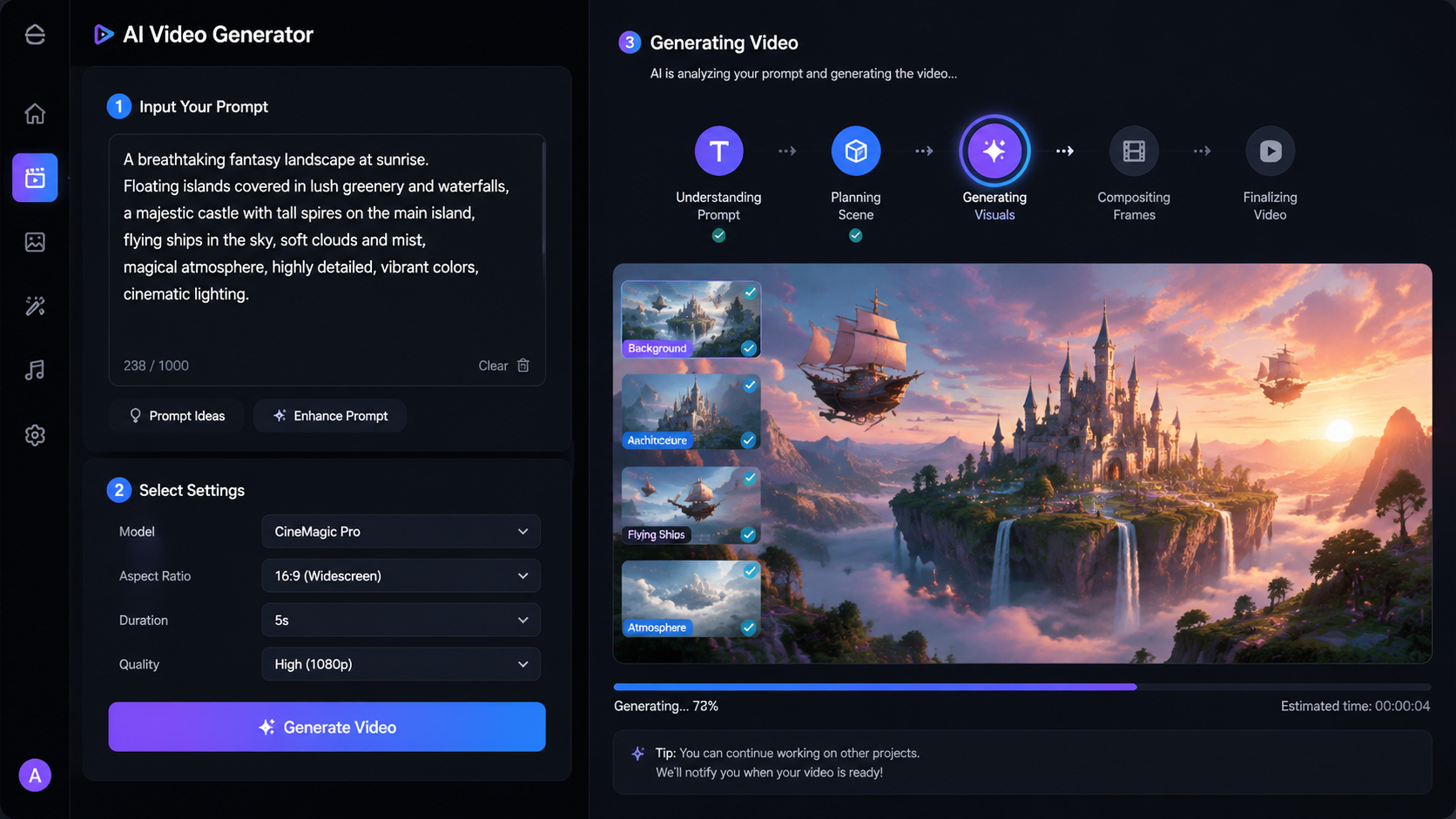
Text to video AI breaks down language and accessibility barriers like never before. Platforms can instantly generate videos with accurate lip-synced voiceovers in dozens of languages, complete with matching subtitles. This localization happens at a fraction of the cost and time required for human translation and dubbing.
Statistics from Bayelsa Watch show that 78% of global marketers now use AI video tools for multilingual campaigns, up from just 32% in 2025. The technology particularly benefits educational content—e-learning platforms report 45% higher completion rates when courses offer AI-generated video translations versus text-only alternatives.
Accessibility features are equally transformative. AI tools automatically add closed captions, audio descriptions, and sign language overlays. Digen AI's 2026 update introduced real-time ASL avatar generation, making videos accessible to deaf audiences without expensive human interpreters. These inclusive features are becoming standard across top platforms, driven by both ethical considerations and expanding market reach.
Localization Features in Modern AI Video Tools
• Instant translation of scripts and voiceovers with native-speaker accents
• Automatic subtitle generation with proper timing and formatting
• Culture-appropriate visual adjustments (colors, gestures, symbols)
• Regional compliance with accessibility laws (WCAG, ADA, etc.)
5. Data-Driven Optimization
Modern text to video AI doesn't just create content—it improves it using performance data. Platforms now integrate with analytics services to test different video versions, optimizing for engagement metrics. This represents a major evolution from static video production to dynamic, continuously improving content.
According to PCMag's 2026 review of Final Cut Pro's AI features, automated A/B testing can increase viewer retention by 20-35%. The system might adjust pacing, background music, or visual styles based on real-time feedback. Some enterprise platforms even personalize videos for individual viewers, changing examples or product recommendations based on user profiles.
Digen AI Agent takes this further with its predictive analytics module. By analyzing thousands of high-performing videos in a given niche, it suggests optimal structures for new content. For instance, cooking tutorials might perform better with specific camera angles, while tech reviews need certain types of animations. This data-driven approach removes guesswork from video creation.
6. Future-Proofing Content Strategy
Adopting text to video AI positions businesses for ongoing technological shifts. As noted in The AI Journal's VeoE AI coverage, 2026's tools already incorporate emerging formats like volumetric video and augmented reality overlays. Early adopters gain experience with next-generation media while competitors struggle with outdated production methods.
The content repurposing capabilities are equally valuable. A single text script can spawn vertical videos for TikTok, square clips for Instagram, and widescreen versions for YouTube—all automatically formatted. Simplilearn reports that 65% of social media managers now use AI to adapt content across platforms, up from 22% in 2025.
Perhaps most importantly, AI video tools future-proof against talent shortages. The Bayelsa Watch statistics reveal a 180% increase in video content demand since 2025, far outpacing the growth of skilled editors. Platforms like Digen AI fill this gap, enabling consistent quality regardless of team size or expertise. As video becomes the dominant content format, these advantages will only grow.
Frequently Asked Questions
How accurate are AI-generated voiceovers in text to video tools?
Modern AI voiceovers achieve 98% naturalness scores according to 2026 benchmarks, with emotional inflection and proper pronunciation. Platforms offer hundreds of voice options across languages and dialects.
Can text to video AI create long-form content like documentaries?
Yes—advanced systems like Digen AI Agent now support 30+ minute videos with coherent narratives. The 2026 Veo 3 update specifically improved long-form consistency through enhanced memory architectures.
Do I need video editing skills to use these tools?
No—text to video AI platforms are designed for beginners, automatically handling editing tasks. However, professionals can use tools like Final Cut Pro's AI features for finer control.
How does AI ensure brand consistency in generated videos?
Leading platforms let users upload style guides, logos, and approved color palettes. Digen AI's Character Lock feature maintains consistent mascots or spokespeople across all content.
What's the typical output quality of AI-generated videos?
Most 2026 tools produce 1080p or 4K resolution videos with professional-grade visuals. High-end solutions like VeoE AI achieve near-cinematic quality for demanding use cases.
Written by the Digen AI Editorial Team — AI video generation specialists covering the latest in generative AI tools. Learn more about Digen AI.



Comments ()